
Help page

JSONBuddy Help

JSON Schema editor

Mark the document as a schema, review its diagnostics and sample data, then test an associated JSON instance deliberately.

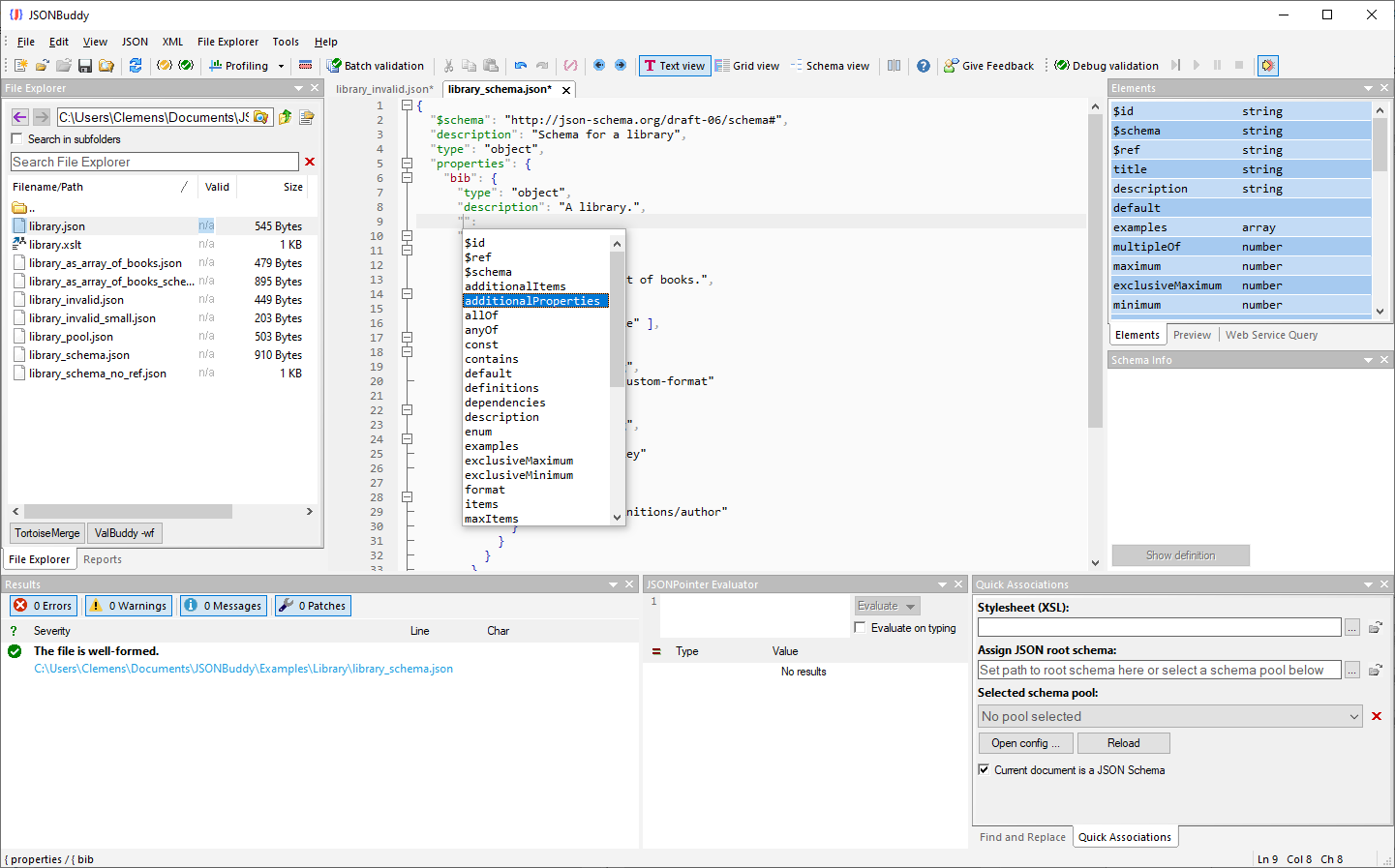
JSONBuddy for Windows showing a JSON Schema document with schema-aware syntax highlighting and the Quick Associations pane
Authentic supplied Help evidence of schema-aware editing in the Windows product; exact controls, drafts, and results must be confirmed in the current build.
Current-build check

The supplied read-only Help source documents this task. Confirm schema association, keyword assistance, validation, preview, and diagnostic behavior in the current Windows build before standardizing a procedure.

Prepare the schema document

  1. Open the intended schema file and keep a small JSON instance that represents the contract.
  2. Use the current association control to mark the active document as a JSON Schema.
  3. Confirm the chosen draft, root resource, and referenced-schema context before editing rules.

The legacy Help describes schema-aware syntax coloring, keyword auto-completion, and interactive specification text. These are useful editing aids, not proof that a particular keyword or draft is appropriate for the contract.

Validate the schema before testing data

Run the current schema-validation workflow and inspect each result at its reported location. Correct the schema deliberately, then repeat the check. The supplied evidence shows a type mismatch in a required array and a Results pane; verify current wording, severity, and jump-to-result behavior in the active release.

Associate a JSON instance and test the contract

  1. Open the JSON instance that the schema is meant to constrain.
  2. Associate the intended schema using the current Windows workflow; use a relative path only after confirming resolution from the saved files.
  3. Validate the instance and inspect both the JSON location and applicable schema location.
  4. Retest one expected-valid and one expected-invalid sample after each meaningful schema change.

The historical Help also describes generated sample data and background indicators. Verify their availability and refresh timing before depending on either as a release guarantee.

Continue with a focused schema task

Use the SchemaStore library task to start from a published schema, the JSON Schema debugger for a repeatable failing case, or the JSON Schema editor overview for the full capability.

Author schema structure with reviewable intent

Use names, descriptions, and examples that explain the contract to the next maintainer. Add object properties, arrays, and constraints in small changes, then validate the schema after each logical group. If an editor suggests a keyword, check that it belongs to the chosen draft and that its value has the intended type. Do not copy a keyword solely because it appears in a suggestion list or a historical screenshot.

When a schema uses references, keep the referenced documents available in the same controlled test set. Resolve a reference deliberately, inspect the target resource, and confirm that the resulting rule still applies to the instance path you intended. A successful lookup is not enough: test a fixture that depends on the referenced rule.

Use generated samples as inspection material

The supplied Help source describes a text preview of generated JSON sample data. A sample can reveal the shape implied by a schema, but it is not a complete test suite and may omit boundary cases. Review required properties, arrays, nested objects, enumerations, and constraints with representative valid and invalid fixtures. Save any useful sample separately from the schema until its status has been reviewed.

Read diagnostics in context

When a schema or instance check reports an issue, first decide whether the failing value, the rule, or the schema association is wrong. Use the reported location to inspect the nearby content, correct one cause, and rerun the same case. Keep a short record of expected pass and fail cases when a schema is shared by several files or services.